A dispute occurs when a cardholder disputes a charge with their bank which was made to their credit/debit card for the booking of a product/service. It is a reversal of a payment initiated by the customer
What is the process when a dispute is received?
When a dispute is received, the amount is immediately deducted from the merchant’s Payyo balance by the card issuer and placed on hold until the dispute has reached a conclusion. Payyo will then contact the merchant and request further information to confront the claim.
- Reason for the dispute
- Booking ID
- Deadline for responses
- A link to the Payyo support pages for more information
Payyo acts as an intermediary between the merchant and the customer’s bank/credit card company.
A dispute can be opened for various reasons.
Dispute Lifecycle
- Payyo receives a notification from the acquirer that the cardholder has opened a chargeback.
- The money is immediately returned to the card issuer. The transaction amount will be deducted from the merchant’s balance.
- Payyo notifies the merchant by email to contact the customer and send us any relevant information and correspondence that could be used to help dispute the claim.
- Payyo will forward any relevant information received to the issuing bank for their review.
- The card issuer will review the information and inform Payyo of the outcome
- Payyo notifies the merchant of the outcome
If the merchant does not reply within 3 days, the chargeback is treated as accepted and the dispute is marked as “lost”.
There are two possible outcomes of the dispute:
LOST: If the decision is closed in the cardholder’s favour, a dispute will be marked as lost and the money will be returned to the cardholder’s account. A fee will also be added to the merchant’s account.
WON: If the information provided was sufficient to dispute the cardholder’s claim, the case will be marked as won and the funds will be returned to the merchant’s balance.
The Dispute lifecycle
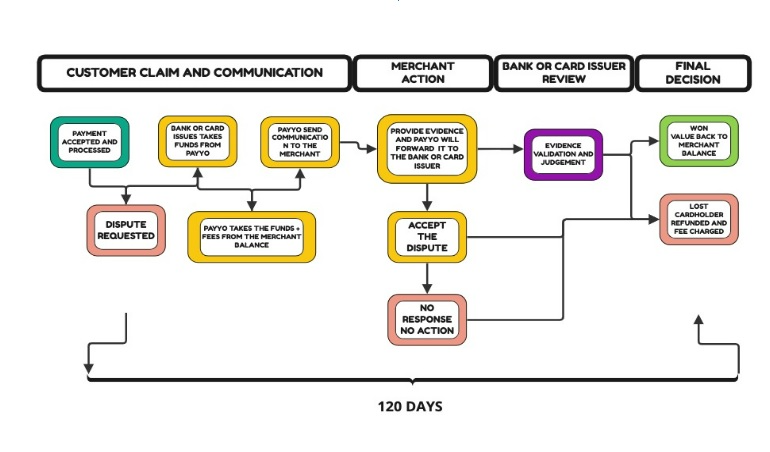
Understanding the dispute reasons and how to proceed
It is important to understand the reasoning for a dispute. There are several reasons why a dispute can be opened.
Not Authorized or Not Recognized
These disputes occur when a cardholder claims that they did not authorize a transaction or does not recognize a transaction on their credit card statement. The merchant must provide evidence that the cardholder did authorize the charge in order for the dispute to be resolved in their favor.
Unsatisfactory Products or Services
These disputes occur when a cardholder claims that they received a product or service that was defective, not as described, or not of the quality that was expected. The merchant must provide evidence that the product or service was exactly as described for the dispute to be resolved in their favor.
Refund Not Issued
These disputes occur when a cardholder claims that they have requested a refund from the merchant but have not received one. The merchant must provide evidence that the requested refund was invalid for the dispute to be resolved in their favor.
Service Not Provided
These disputes occur when a cardholder claims that they did not receive a service they paid for. The merchant must provide evidence that the service was received in order for the dispute to be resolved in their favor.
It is essential to forward evidence to reverse the dispute. This includes cases where the cardholder claims to have canceled the dispute on their side.
By providing information to fight the dispute advises the card issuer that the merchant does not accept the case and they want to confront the dispute
What actions can be taken to reduce the number of disputes received and to protect the business?
***PLEASE NOTE: This information should be treated as a guideline and will not prevent disputes***
The outcome of a dispute is completely reliant on the information the merchant can provide. The more information provided, the higher the chances of winning the dispute.
As disputes are not completely preventable, we have listed some measures that could help reduce the number of cases that are lost:
- Upon arrival or before the service is provided, take a copy of the customer’s ID and get them to sign beside the photocopy.
- Always communicate with the customer and try open a dialogue with them
- If possible, try to verify the card details that were used at the time of the booking. The merchant receives the first 6 and last 4 digits of the card.
- Complete order forms, especially those outlining special requests.
- Regular communication logs between the merchant and the customer before and after the product/service have been received.
- Prove the cardholder received the product/service by taking photos, social media posts and tagging them, etc.)
Timeframes of customers, banks or issuers, and merchant
- How long does a cardholder have to open a dispute?
- This varies from the card issuer, but typically cardholders have up to 120 days from the transaction date or service date, whichever is most recent.
- What is the deadline for merchants to reply to the dispute communication?
- Payyo merchants have 48 business hours to reply to disputes communication, so if a dispute communication takes place on Friday at 4 pm the merchant has until Tuesday at 4 pm to reply to the dispute, in case of no reply the dispute will be closed due to merchant inactivity and the case will be closed in favor of the cardholder.
- How long does it take to have a conclusion after submitting the relevant dispute information?
- The card issuer can take up to 90 days after the dispute is filed. There is no possibility to speed up this timeframe.
- Getting in touch with your customer is crucial to speed up the process. As the cardholder has initiated the dispute, the request can also be closed from them at any stage. The cardholder must provide proof of dispute cancellation from their card issuer. Otherwise, it can take the full 90 days to receive the outcome of the dispute.
Disputes that can’t be confronted
SEPA Direct Debit and Cartes Bancaire
Direct Debit disputes Cartes Bancaire are a little different from regular disputes. The main difference is that they can not be challenged by the merchant and therefore, the dispute has to be accepted without further inquiry. The fee will be applied to the merchant’s account.
There can be several reasons why a customer disputes a Direct Debit transaction:
- The customer does not recognize the transaction on their bank statement or the transaction was fraudulent and the cardholder was not aware their credit/debit card was being used for this purchase.
- The service was not provided and a full refund was expected to be made to the cardholder. The cardholder may have canceled this and did not follow your T&Cs or maybe the refund was not issued.
- The service was not as expected/described in the description and a partial refund was expected from the cardholder.
Please contact the customer immediately to clarify the reason for the chargeback. It is quite possible this could be a misunderstanding and can be resolved by contacting the customer directly.
The Direct Debit dispute time frames are a bit different:
Disputed within 8 Weeks: Customers are able to dispute a SEPA Direct Debit transaction on a “no questions asked” basis, meaning the funds will automatically be returned to them.
Between 8 weeks and 13 months: Customers are still able to dispute transactions during that period. The arbitration process involves both the acquiring bank and the customer.
After 13 months: Disputes are no longer possible.
Was this article helpful?
That’s Great!
Thank you for your feedback
Sorry! We couldn't be helpful
Thank you for your feedback
Feedback sent
We appreciate your effort and will try to fix the article